Pass, Grubber or Chip: Three Ways to Put the Ball into Space
Compare a rugby pass, grubber and chip by height, pace and intended receiver, so you can read the space each choice targets and follow the next play.
The common mistake is to judge a rugby pass, grubber and chip only by where the ball ends up. That misses the more useful clue: who is meant to take the next action, and what route the ball gives them. A clear target makes the choice easier to read, even when the play does not work.
Start with the target
Before judging the technique, ask where the ball is meant to arrive and who is expected to collect it. A pass usually has a teammate as its target. A grubber or chip may be aimed at a patch of grass, with the kicker or a supporting runner chasing the ball into it.
The choice depends on the space available, the defenders’ positions and the support nearby. A passing lane may be blocked while grass behind the defensive line is open. In another moment, kicking may give the defence time to turn, while a quick pass can keep the attack moving across the field.
Height, pace and intended receiver help distinguish the options. Height affects how long the ball is in the air; pace affects how quickly it reaches its target. The receiver tells you whether the play depends on a catch, a chase or a bounce.
Pass to a teammate
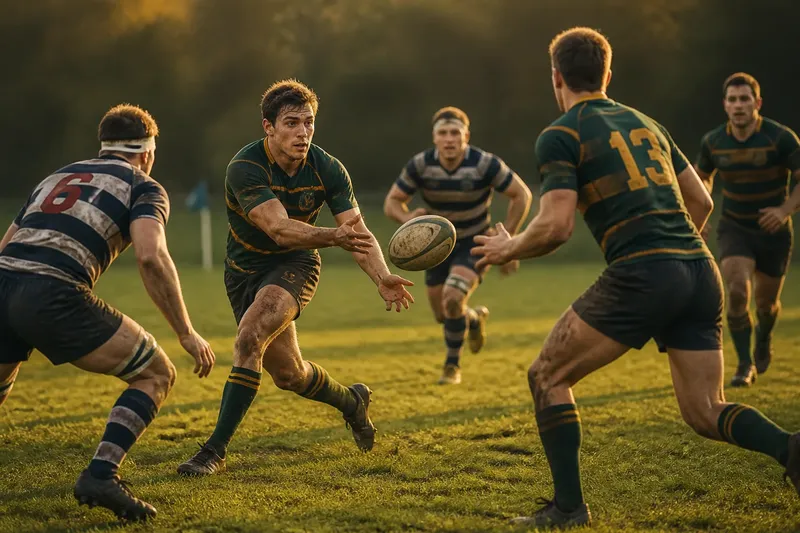
A pass suits a moment when a teammate is available and the ball can reach them without travelling forward. In ordinary back play, it moves laterally or backwards and keeps possession in the attacking team’s hands. The receiver can catch it and make the next decision without first gathering a bounce.
The ball’s pace must suit the receiver. One sent too slowly can allow a defender to close the gap; one fired too hard may be difficult to gather while running. The passer also needs to account for the teammate’s movement, often leading them into space rather than aiming at where they are standing.
If a pass stalls the attack, look at the timing and target. The receiver may be stationary, the passer may have waited until a defender was close, or the ball may have been aimed behind a runner. The useful clue is whether the teammate had room to catch and act.
Grubber through ground space
A grubber is a low kick that travels along or close to the ground, often with forward rotation. It can send the ball through a gap or behind advancing defenders. Rather than offering a straightforward catch, it asks a chaser to reach the ball after it bounces or rolls.
The bounce is difficult to predict precisely. Turf, a slope and the angle of the kick can all alter the path. A soft grubber may give defenders time to turn and collect it; one that runs too far may leave the chasing side without a realistic chance to regain possession.
Watch for a supporting runner close enough to chase before the kick is made. Open grass alone is not enough: someone needs to contest or recover the ball. If a teammate is available for a catch, a pass may be the clearer option; if the useful space is above a defender, a chip may suit it better.
Chip over a defender
A chip is a short, lifted kick intended to pass over or around an advancing defender and drop into space. The kicker or a supporting teammate follows it. Unlike a grubber, it gives the ball height and airtime; unlike a long kick, it is generally directed towards a nearby contest.
That arc can get the ball over a defender who is rushing forward, but the extra time in the air also gives defenders a chance to turn, track it and challenge for the landing. If no attacker is close enough to contest the drop, the defence may collect it without pressure.
When the opposition gathers a chip, look at the space behind the defender and the attackers’ starting positions. The intended receiver might be the kicker, a fast teammate or several players arriving together. If nobody can reach the landing area in time, a pass may preserve possession more sensibly.
Choose by the available route
Say an invented move starts with a defender stepping forward to close the passer. A teammate is running into open grass behind that defender, and the attack has a runner close enough to chase. If a clear lateral route remains, the passer can send the ball to the teammate’s path. If the defender blocks that route but ground-level space remains open, a grubber with the runner chasing is another possibility. If the gap is above the defender and the runner can challenge for the drop, a chip may fit better. Each choice gives the supporting player a different job.
- Pass: If a teammate is moving into a clear lateral lane, pass ahead of their path; if the lane is blocked, look for another receiver or route.
- Grubber: If the ground behind the defence is open and a chaser is close, kick low into that space; if no chaser can arrive, keep the ball in hand or choose another option.
- Chip: If a defender blocks the ground route but a runner can contest space above them, lift the ball; if the defence can reach the landing area first, reconsider the kick.
- Pass pace: If the receiver is running at speed, lead them with a catchable ball; if they are held up or stationary, adjust the target and pace rather than sending it behind them.
- Chaser position: If a support runner is already moving towards the target space, the kick has a possible follow-up; if teammates are far behind, favour a route they can support.
- Defensive pressure: If the defender is rushing forward and space is open behind, consider a kick over or through; if several defenders are covering that space, look for a teammate in a clearer lane.
These are useful tendencies, not rigid definitions of every kick. Technique, angle, surface and the surrounding players affect the outcome. When watching, follow the intended target and the supporting runner rather than judging the choice by the ball’s path alone.
Which option fits the space?
What is the difference between a grubber and a chip?
A grubber travels low and uses the ground, while a chip rises over a defender before dropping. Both usually depend on a chase, but each asks the chaser to judge a different path and arrival point.
Who is meant to receive a grubber?
Usually a chaser, who may be the kicker or a supporting teammate. The target is often space for someone to reach, rather than a player waiting to catch the ball.
Why might a defender catch a chip?
The defender may have time to turn and reach the landing point, particularly if the ball hangs in the air or no attacker is close enough to challenge. Check whether an attacking runner was in position before the kick.
Can a pass be aimed into space?
Yes. A passer can lead a moving teammate into a gap, but the teammate remains the intended receiver and must be able to catch the ball. A kick into space instead asks a player to chase and recover it.
Read the next action
When watching a match, identify the intended receiver before the ball arrives. If a teammate catches it, follow the space they can attack next; if a kick goes beyond the defence, follow the nearest chaser and watch who reaches the ball first. The likely target often explains the decision better than the final bounce.
For a rugby pass, grubber or chip, the useful comparison is the route each offers through the defence: a teammate’s hands, ground-level space or a gap above a defender. That distinction helps you track who is responsible for the next action, even when the ball changes direction unexpectedly.